A 2026 peer-reviewed study finds that, as things stand, AI is helping oil and gas more than it’s helping the climate, adding more emissions than it avoids. For any organization using AI, the direct footprint of data centres is only part of the picture.
Tech leaders and international institutions have spent the last few years promoting AI as essential to the ecological transition, among other promises. In its 2025 Energy and AI report, the International Energy Agency (IEA) estimated that widespread adoption of AI could avoid up to 1.4 gigatonnes (billion tonnes) of CO₂ equivalent per year by 2035, about 3.3% of global emissions. Those savings would come from making factories more efficient, spotting methane leaks at oil and gas sites, running buildings better, and helping power grids handle more wind and solar.
But this scenario only counts the upside. There’s an elephant in the room, and it’s bigger than any data centre. AI gets deployed inside the industries we already have, including the ones most responsible for environmental damage, like oil and gas.
Once you start to evaluate all of AI’s effects, including the indirect ones, the illusion of "green AI" becomes much harder to defend. Without rules or regulation, AI risks deepening our dependence on fossil fuels, and on current trends it enables more emissions than it helps avoid.
AI could still do real good for the climate. The problem is direction and scale. AI amplifies whatever system it’s plugged into, and today’s energy system still runs on more than 80% fossil fuels.
AI enables more emissions than it avoids
A 2026 peer-reviewed study in npj Climate Action, a Nature journal, by Will Alpine, Holly Alpine and colleagues, is the first to model at global scale both the emissions AI helps avoid and the new ones it makes possible. AI makes renewables more efficient, and it makes oil and gas cheaper to extract and produce. Its net effect on the climate depends on which side wins that race.
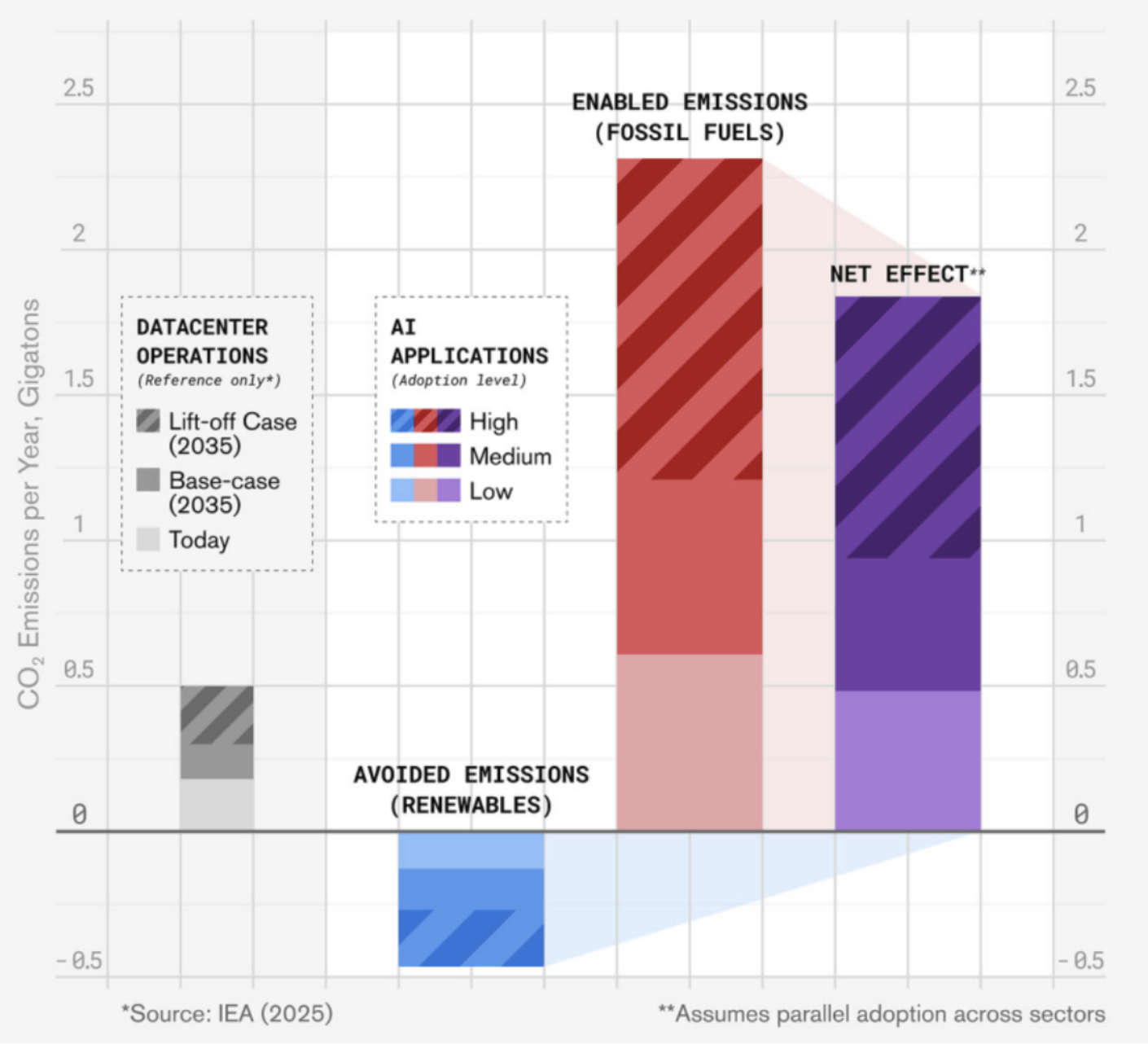
AI works in two directions at once. In clean energy, it can make batteries more efficient or help power grids run on more wind and solar. That cuts emissions, and researchers call these avoided emissions. In oil and gas, the same technology helps companies find new reserves, get more out of existing fields and cut drilling costs. When AI makes an oil well cheap enough to be profitable, that oil gets pumped and burned. Those are enabled emissions, the extra emissions that only happen because AI made the fuel worth producing.
The result is lopsided. In the study’s scenarios, whenever AI makes fossil fuel production more productive, the extra emissions outweigh everything AI saves elsewhere. To break even, AI would need to boost renewable energy four to five times more than it boosts oil and gas. The authors are clear about how the system responds. It isn’t a prediction of exact future emissions.
Most of this imbalance comes from AI making it faster and cheaper to find and extract oil and gas. According to the International Energy Agency (IEA), global oil production would fall by about 8% a year without new investment, and gas even faster. Companies have to keep spending just to stand still. AI makes that spending go further. It helps them pump more from existing fields and makes oil and gas that wasn’t worth drilling profitable.
Put together, AI’s net effect is an increase of 0.47 to 1.8 gigatonnes of CO₂ a year, or 1.2% to 4.8% of global energy emissions in 2024. At the top end, that’s roughly three times what Germany emits in a year. That’s the elephant. The emissions AI enables in oil and gas are 3.3 to 13.3 times larger than the emissions of every data centre in the world today. The study’s authors also run the Enabled Emissions Campaign, which has a plain-language summary of the research and documented examples of AI in oil and gas.
The iceberg: what we see and what we don’t
To understand why efficiency gains alone are not enough to decarbonize, we need to look beyond AI’s direct impacts. Those are only the tip of the iceberg. Most conversations about AI’s footprint stop there, meaning the electricity and water data centres use and the hardware they run on. That’s real, but it’s the smallest part.
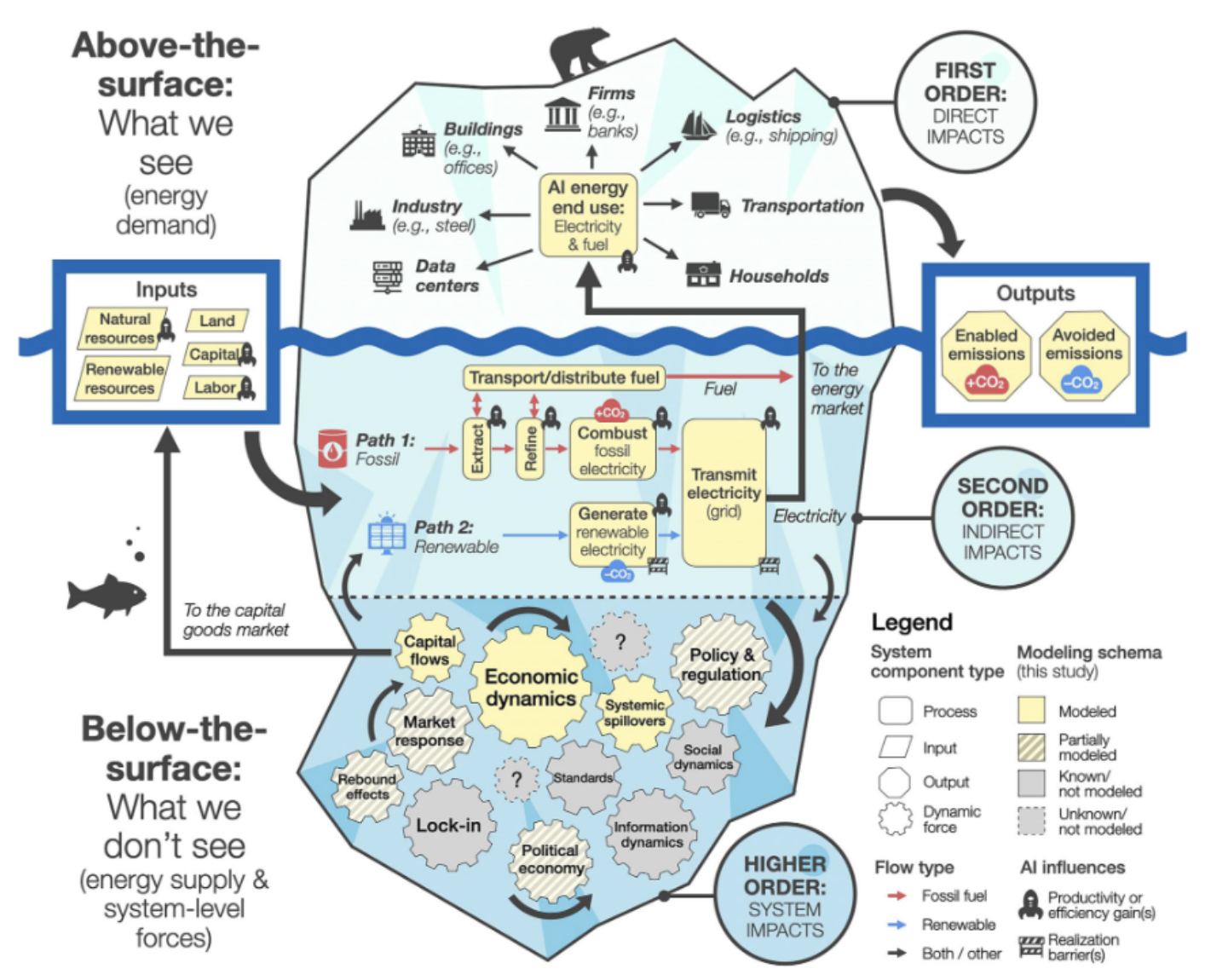
International standards back this up. ITU-T L.1480, from the UN agency for digital technology, recognizes that most of the climate impact of digital solutions happens at these indirect levels.
Three effects explain what happens below the surface:
Rebound effect:
When technology makes something cheaper and more efficient, people use more of it, and the extra use can wipe out the savings. This is often called Jevons’ paradox. In oil and gas, AI that cuts drilling costs makes more wells worth drilling, and cheaper oil keeps demand high.
Induction effect:
When technology makes new things possible, those new things use energy and resources too. For example, in oil and gas, AI can find oil that older methods missed, and that oil then gets drilled and burned.
Catalyst effect ("AI for oil and gas"):
The Shift Project describes AI as an amplifier of the system it runs in. Deploy it without clear climate targets in an economy that still runs on more than 80% fossil fuels, and you get AI that runs on fossil fuels too. The same cloud and AI tools tech companies promote as climate solutions are also sold to oil companies to boost production.
Why organizations need to measure net impact
Organizations can’t assume that digital optimization or "AI for green" projects cut emissions on their own. To know whether AI is actually helping, they need to look beyond their direct footprint and measure what changes because of it, across carbon and other impacts like water and materials. AI amplifies the economic and institutional rules of the system it runs in. If prices and business models ignore the climate, AI will speed up the fossil fuel industry and push emissions up.
So for any organization using AI, the real question is what it’s amplifying. Decarbonade helps organizations answer that. Our Net Environmental Assessment looks at the direct footprint of your AI and digital tools, and at what they change beyond it. If that would be useful, get in touch.
FAQ
What are "enabled emissions" in the context of Artificial Intelligence?
Enabled emissions are the extra emissions that happen when AI makes oil and gas cheaper or easier to produce, for example by finding new reserves or making a new well profitable. They’re separate from the energy AI itself uses.
Will AI generate more carbon emissions than it could avoid globally?
Likely yes. When a 2026 study in npj Climate Action modelled AI being adopted at similar rates across fossil fuels and renewables, net CO₂ emissions rose by 0.47 to 1.8 gigatonnes a year. Emissions only fell in scenarios where AI didn’t make fossil fuel production more productive.
How can AI help the environment?
AI can make power grids and renewables work better, spot methane leaks, and cut energy waste in buildings and industry. Those gains matter. But the npj Climate Action study found they aren’t enough on their own to make up for the boost AI gives oil and gas, so both sides need to be tackled together. Even the International Energy Agency warns that emissions savings from digital technologies “are not on track to materialise without regulatory and other interventions.”
How can my organization measure the real net environmental impact of our digital portfolio?
You need an assessment that measures what changes because of your digital tools, including effects in other sectors, on top of your direct footprint. This is called a consequential life cycle assessment, and ITU-T L.1480 sets out how to do it for digital solutions.
Sources
- Alpine, W., Geldner, N., Alpine, H., & Chepeliev, M. G. (2026). AI-driven productivity gains enable more CO₂ emissions than they avoid in a global energy–economy model. npj Climate Action.
- Energy Institute. (2025). Statistical review of world energy.
- International Energy Agency. (2025). Energy and AI.
- International Energy Agency. (2025). The implications of oil and gas field decline rates.
- International Telecommunication Union. ITU-T L.1480: Enabling the net zero transition (add year).
- Lange, S., Frick, V., Gossen, M., Pohl, J., Rohde, F., & Santarius, T. (2023). The induction effect: Why the rebound effect is only half the story of technology’s failure to achieve sustainability (add journal).
- Luccioni, A. S., Strubell, E., & Crawford, K. (2025). From efficiency gains to rebound effects: The problem of Jevons’ paradox in AI’s polarized environmental debate (add venue).
- The Shift Project. (2025). Artificial intelligence, data, computation: What infrastructures for a low-carbon world?