Interview excerpted and translated from French from the newsletter De la Tech à la Terre, Inspiring interviews and reflections for a more sustainable and responsible digital world.
Conducted by Yannick Bole-Richard, Consultant in Responsible Digital Technology & Generative AI • Consulting, Awareness-Raising & Training
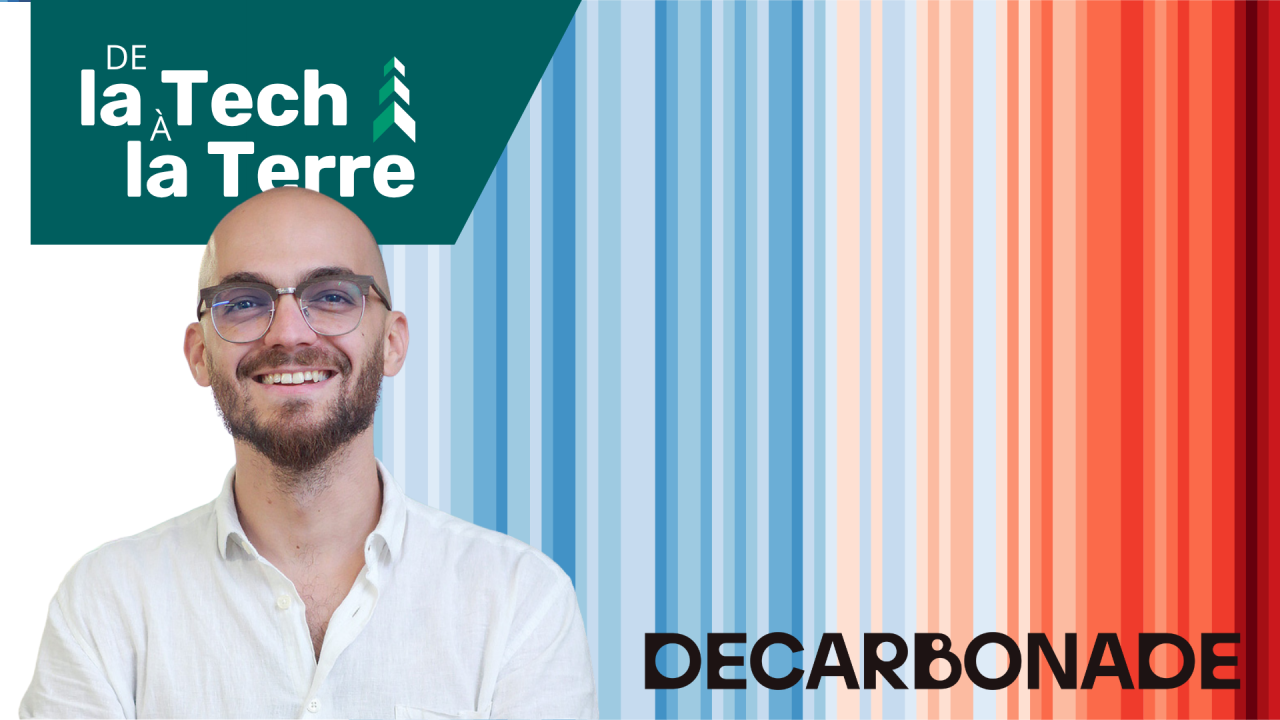
Through a career marked by entrepreneurship, profound self-reflection, and a growing commitment to climate issues, François Burra has gradually moved away from a performance-driven approach to digital technology to embrace a more systemic, critical, and engaged vision.
Now a consultant specializing in decarbonization and digital sobriety, a trainer, and co-founder of several initiatives in Quebec and internationally, he works at various levels—with businesses, governments, and community groups—driven by the conviction that digital technology can no longer be viewed solely as a technological tool, but as a fundamental societal choice.
What’s your background, and how did you come to work on these issues?
François: “I started my career in Montreal after a fairly traditional path through business school, focusing on marketing and business development. Very quickly, I shifted toward UX design and then product management. I worked at agencies and startups, notably at a fintech company that was acquired—which was a great professional success… but also a very difficult experience on a personal level.
I completely burned out. I suffered from depression. And that was a turning point. I took a year to recover, go to therapy, and think about what I really wanted to do.
That’s when I took a three-month course at Terra.do (an online climate school). As I worked on my climate action plan, I realized the enormous impact of digital technology. And rather than completely changing careers, I told myself: I’m going to use my skills to transform my industry from the inside out.
I took the plunge and started my own business—rather abruptly, without a very structured plan. But I had one strong determination: to stay true to my values and choose my projects carefully.”
In practical terms, what do you do today?
François: “I wear several hats. First, through my company Decarbonade, I provide training, raise awareness, and offer consulting services. I work on digital decarbonization, digital eco-design, the environmental impacts of digital technology, and AI. I train thousands of people, both in companies and government agencies. I also measure environmental footprints and support projects in digital eco-design.
Second, I co-founded a collective in Quebec called the Responsible and Sustainable Digital Collective (Collectif NRS). There, the goal is different: we’re seeking systemic impact. We work with governments, conduct research, map infrastructure, and try to influence public policy.
And finally, I created Climate Product Leaders, a playbook dedicated to product managers. Because I felt there was a lack of a specific framework for that role, which is central to decision-making."
When you talk about digital decarbonization, what exactly are we talking about?
François: “In my vocabulary, digital decarbonization isn’t just about carbon. It encompasses all environmental impacts: energy, water, resources, rare metals…
For me, there are three dimensions. First, optimization: doing better with less. Second, restraint: not doing something when it’s not necessary. And finally, purpose: why we’re developing these technologies, and for what end.
Today, we often treat responsible digital technology as merely a layer of optimization. But we’re still operating within the same system. We make small improvements, but we don’t question the overall direction. Yet if the purpose remains hypergrowth and extraction, we’re only amplifying the problems. For me, the question of use (and even non-use) is just as important as that of efficiency."
It is essential to distinguish between two things. Traditional AI—machine learning—has been around for a long time. It is useful, effective, and can even be a solution to climate change.
Generative AI, on the other hand, is very different. It consumes an enormous amount of energy, is concentrated among a few players, and currently has virtually no positive impact on the climate.
You seem to be questioning much more than just technical practices…
François: “Yes, because today, we no longer really have a vision for society. We have a technological and capitalist vision, driven by a few players—often in California—who impose choices on us. And in that model, environmental and social considerations are secondary. So even if we optimize, we’re still operating within a system that produces negative impacts. For me, digital decarbonization must also challenge this direction.”
You also work with governments. How are these issues perceived?
François: “There’s a lot of curiosity, but also a lot of misunderstanding. People sense that there’s a problem, but they don’t always know what it is or how to address it. In Quebec, there’s a willingness to engage. In the United States or other Canadian provinces, it’s often approached from an economic angle: how to reduce costs.
When we show that eco-design can improve performance (speed, SEO, conversion rates, costs, etc.), it changes their perception. People realize that there aren’t just constraints, but also opportunities.”
And what about laws and policymakers?
François: “Right now, we’re still mainly focused on raising awareness and providing training. Laws are few and far between, and they take a long time to implement. We need a shared sense of urgency and maturity for this to move forward. For now, sovereignty is a topic gaining traction more quickly because there’s a major geopolitical stake involved. But when it comes to digital moderation or environmental impact, we’re not there yet. We’re making progress, but slowly.”
How do you feel about this disconnect between the urgency of the issue and the slow pace of change?
François: “We’re heading in the right direction, but clearly not fast enough. There are very powerful forces opposing us, particularly capitalist ones. And there’s no single solution: we need to act on all levels simultaneously. Raising public awareness, transforming businesses, local action, political influence… all of this must move forward at the same time. But we don’t really have a choice. The alternative would be to do nothing. And that, in my view, is not an option."
What’s your take on artificial intelligence today?
François: “It’s absolutely essential to distinguish between two things. Traditional AI—machine learning—has been around for a long time. It’s useful, effective, and can even be a solution to climate change.
Generative AI, on the other hand, is very different. It’s extremely energy-intensive, concentrated among a few players, and today it has virtually no positive impact on the climate.
We lump everything together under the term ‘AI,’ which creates confusion. And it gives the impression that generative AI can be a solution, which isn’t the case.”
How would you describe the overall impact of generative AI?
François: “It reinforces the status quo. It accelerates a system that’s already problematic. It reinforces capitalist logic, consumes enormous amounts of resources, exacerbates inequalities, and is used primarily for non-essential purposes. So clearly, right now, it’s not good news for the environment.”
Despite all that, you also work on these topics. Why?
François: “Because the technology is here. We can’t pretend it doesn’t exist. So we need to educate, raise awareness, and provide guidance. We need to explain when it’s relevant and when it isn’t. And above all, we need to restore critical thinking. The goal isn’t to reject it indiscriminately, but to use it thoughtfully and precisely.”
Finally, can you share a few resources that inspire you on these topics so we can explore them further?
François: “I encourage people to check out websites like Bonpote or Carbonbrief.”